


If you’re planning to start a business in Dubai, one of the first decisions you’ll face is this:
Do you need an industrial license or a commercial license?
A surprising number of entrepreneurs get this wrong.
They assume all trading or production-related activities fall under the same category. They don’t. Choosing the wrong license can delay approvals, increase costs, or even restrict your operations later.
If your business involves manufacturing, assembly, processing, or packaging goods, you may need an industrial license in Dubai rather than a standard commercial license. And the difference between the two is not just administrative. It affects infrastructure, compliance, approvals, and long-term scalability.
In this guide, you’ll understand:
- What an industrial license actually covers
- How it differs from a commercial license
- Who needs an industrial license in the UAE?
- What impacts the cost of an industrial license in Dubai
- And how to choose the right structure for your business model
Let’s start with the fundamentals.
What Is an Industrial License in Dubai?
An industrial license is required for businesses involved in manufacturing or industrial activities. This includes transforming raw materials into finished or semi-finished products.
In simple terms, if your business produces something physically, you are likely entering industrial territory.
An industrial license in Dubai typically covers activities such as:
- Manufacturing and production
- Assembly of goods
- Fabrication and metal works
- Food processing and packaging
- Textile or garment manufacturing
- Chemical or plastic production
- Industrial-scale printing
This license is issued by the Dubai Department of Economy and Tourism (DET), but unlike standard commercial licenses, it often requires additional approvals.
External Approvals Are Mandatory
For an industrial license in the UAE, you may need approvals from:
- Dubai Municipality
- Civil Defense
- Environmental authorities
- Ministry of Industry and Advanced Technology (for certain activities)
These approvals ensure that your factory, warehouse, or production unit complies with safety, environmental, and zoning regulations.
Infrastructure Is Not Optional
You cannot operate an industrial activity from a small office.
An industrial license in Dubai requires:
- A physical warehouse or factory space
- Compliance with zoning regulations
- Installation of appropriate machinery
- Safety and inspection clearance
This is one of the biggest structural differences between industrial and commercial setups.
Industrial licenses are designed for businesses that produce tangible goods at scale. That’s why regulatory oversight is tighter.
3. What Is a Commercial License in Dubai?
Now let’s contrast that.
A commercial license is issued for trading activities. If your business involves buying and selling goods without manufacturing them, this is typically the appropriate category.
A commercial license covers:
- Import and export
- Retail sales
- Wholesale trading
- General trading
- E-commerce trading (in many cases)
- Distribution businesses
You are not transforming products. You are trading them.
This license does not require factory approvals, industrial zoning, or environmental clearance. The infrastructure requirement is usually limited to an office space or retail outlet, depending on your activity.
Why This Difference Matters
Here’s the key distinction:
- If you manufacture or process goods, you need an industrial license.
- If you buy and sell finished goods, you need a commercial license.
Many businesses start as trading companies and later move into manufacturing. When that shift happens, the license must be updated. Failing to align your license with your actual activity can lead to penalties or operational restrictions.
Understanding this early helps you avoid structural mistakes that become expensive later.
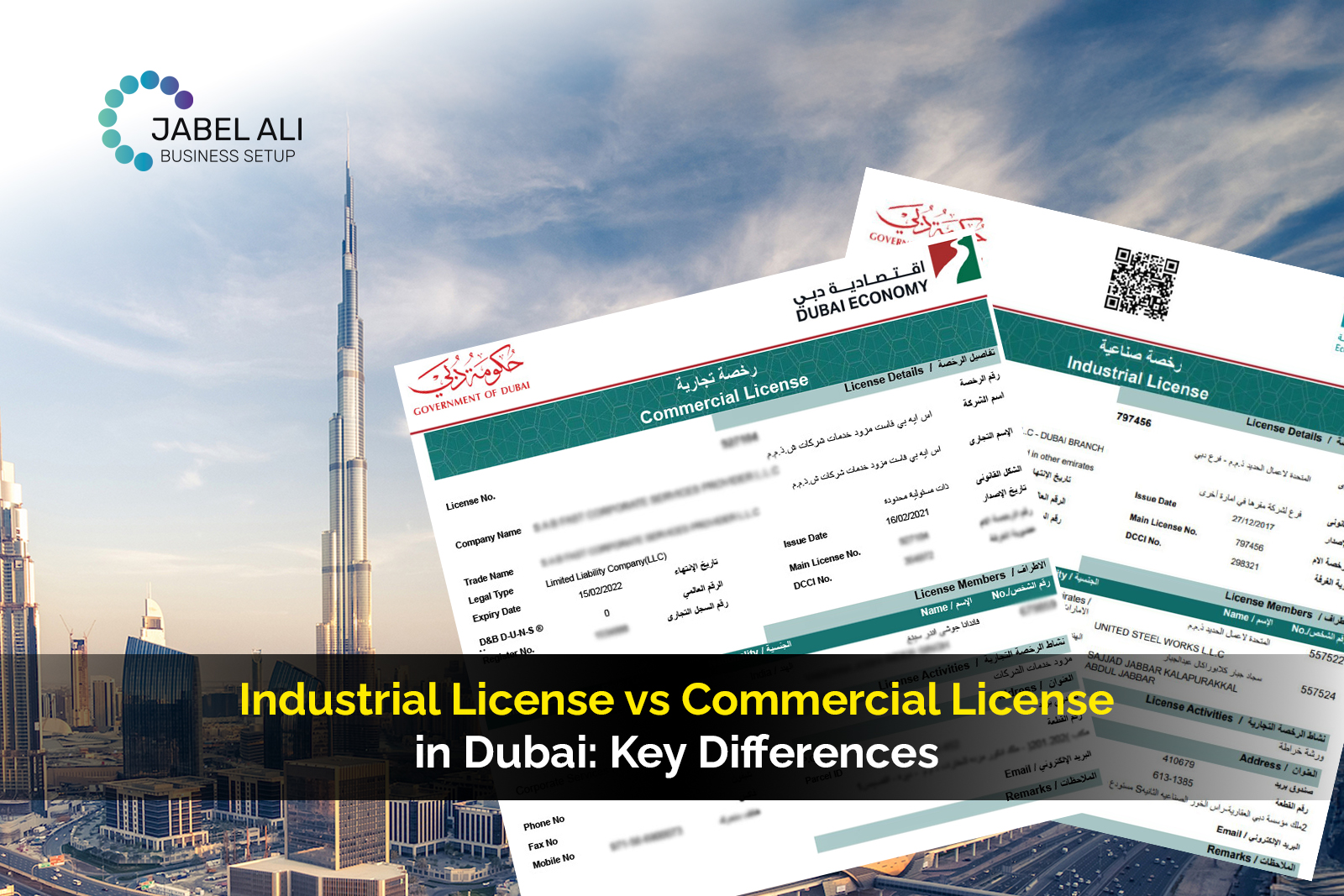
Difference Between Industrial and Commercial License in Dubai
When choosing between an industrial license and a commercial license in Dubai, the decision should be based on your core activity, operational scale, and compliance obligations. Many businesses get this wrong at the planning stage and face delays later.
Here is a structured comparison that clearly outlines the difference between an industrial and a commercial license in Dubai:
| Criteria | Industrial License | Commercial License |
| Nature of Activity | Manufacturing, processing, assembling, and converting raw materials into finished goods | Trading, buying and selling goods, import/export, distribution |
| Infrastructure Requirements | Factory, warehouse, or industrial facility in approved industrial zones | Office space, shop, warehouse (depending on trading activity) |
| External Approvals | Requires approvals from relevant authorities, such as the Dubai Municipality and environmental bodies | Usually requires approval from the Department of Economy and Tourism (DET) only, unless regulated goods are involved |
| Warehouse/Factory Requirement | Mandatory production facility or industrial space | Not mandatory unless storage is needed |
| Capital Intensity | Higher due to machinery, workforce, utilities, and compliance | Lower compared to an industrial setup |
| Regulatory Compliance | Strict inspections, health, safety, and environmental compliance | Standard commercial compliance |
| Processing Time | Longer due to multiple approvals and inspections | Generally faster |
An industrial license in Dubai is subject to greater regulatory oversight because it directly affects public health, safety, and environmental standards. A commercial license, on the other hand, focuses on trading activities without physical production.
If your business transforms raw materials into a product, you need an industrial license. If you are buying and selling finished goods, you need a commercial license.
Who Needs an Industrial License in Dubai?
An industrial license in Dubai is required for businesses engaged in production or manufacturing. If your operations involve any form of material transformation, assembly, or processing, this license becomes mandatory.
Here are the main categories of businesses that require an industrial license in the UAE:
1. Manufacturers
Companies producing furniture, textiles, chemicals, plastics, metal products, electronics, or building materials must obtain an industrial license.
Example: A company manufacturing aluminium window frames from raw aluminium sheets requires an industrial license.
2. Food Processing Units
Businesses involved in food production, packaging, bottling, dairy processing, or bakery production must secure industrial approval.
Example: A facility processing spices and packaging them for retail sale falls under industrial licensing.
3. Assembly Units
Businesses assembling parts into finished goods, even if the components are imported, require an industrial license.
Example: An electronics company assembling imported components into finished devices.
4. Fabrication Workshops
Metal fabrication, welding workshops, carpentry production units, and glass processing facilities fall under industrial activities.
Example: A workshop manufacturing custom steel structures for construction projects.
5. Packaging Businesses
If the activity involves repackaging, labelling, or altering products in a way that adds value, it may require industrial licensing.
Example: A company importing bulk grains and packaging them into retail consumer packs.
In short, if your business changes the form, composition, or structure of a product, you likely require an industrial license in Dubai.
If you’re only trading goods without altering them, then a commercial license would be more appropriate.
Industrial License Dubai Cost: What to Expect
Let’s address the question most people search for before anything else: what does the industrial license in Dubai cost?
The honest answer? There is no fixed number. An industrial license in Dubai is not just a paperwork expense. It is an operational setup cost that depends heavily on your activity, scale, and facility requirements.
Here is how the cost typically breaks down.
1. Government License Fees
This includes:
- Trade name reservation
- Initial approval
- License issuance fees
- Chamber of Commerce registration
For an industrial license in Dubai, government fees are generally higher than commercial licenses due to regulatory complexity. The total varies depending on activity and jurisdiction, but expect it to be significantly higher than standard trading licenses.
Key factor: The more regulated your activity, the higher the compliance cost.
2. Industrial Land or Warehouse Cost
This is usually the largest expense.
An industrial license in the UAE requires a physical production facility. That means:
- Factory space
- Warehouse
- Industrial land in approved zones
Costs depend on:
- Location (Dubai Industrial City, Jebel Ali, Al Quoz, etc.)
- Size of facility
- Power load requirements
- Utilities infrastructure
Industrial spaces in Dubai are priced per square foot annually, and rates vary significantly based on demand and zoning classification.
If you require a high electricity load for machinery, your infrastructure cost increases.
3. Civil Defence Approvals
Industrial operations require strict safety compliance. Civil Defence inspections typically cover:
- Fire alarm systems
- Fire suppression systems
- Emergency exits
- Safety signage
Installation costs depend on facility size and activity type. Manufacturing chemicals, food, or heavy fabrication requires more complex compliance.
4. Municipality Approvals
Dubai Municipality approvals are mandatory for most industrial activities. This includes:
- Site inspection
- Layout approvals
- Hygiene approval (for food production)
- Environmental health review
Fees vary based on activity classification.
5. Environmental Clearance
Some industrial activities require environmental impact assessment approvals.
This is common for:
- Chemical processing
- Metal treatment
- Waste-producing activities
- Manufacturing involving emissions
Environmental compliance can increase both documentation and operational costs. If your activity falls into a regulated category, this becomes a major cost driver.
6. Machinery and Equipment Cost
This is not part of the license fee, but it directly impacts the total setup cost.
Factors include:
- Imported machinery
- Installation
- Testing and calibration
- Maintenance contracts
For many businesses, machinery investment far exceeds the government license fees.
What Actually Determines the Cost of an Industrial License in Dubai?
Instead of asking “How much does it cost?”, ask:
- What is the production scale?
- How large is the facility required?
- What level of regulatory approvals apply?
- What power and water infrastructure is needed?
An industrial license in Dubai is capital-intensive by nature. It is designed for serious manufacturing operations, not small-scale trading setups.
Process to Obtain an Industrial License in Dubai
Now, let’s break down the practical steps to obtain an industrial license in Dubai.
Step 1: Define Your Industrial Activity
Be specific.
“Manufacturing” is not enough. Authorities require precise activity classification, such as:
- Plastic product manufacturing
- Food processing
- Metal fabrication
- Textile production
Your selected activity determines required approvals.
Step 2: Reserve Trade Name
Submit your proposed company name for approval.
The name must comply with UAE naming guidelines and reflect the industrial nature of the business, where applicable.
Step 3: Initial Approval
Apply for initial approval from the relevant authority.
This confirms the government has no objection to you setting up the industrial activity, subject to regulatory approvals.
Step 4: Secure Industrial Land or Warehouse
You cannot proceed without securing an approved industrial facility.
Requirements include:
- Ejari or lease agreement
- Approved industrial zoning
- Adequate infrastructure for the activity
The facility must match the approved layout and safety requirements.
Step 5: Obtain External Approvals
This is the most critical stage.
Depending on your activity, approvals may be required from:
- Dubai Municipality
- Civil Defense
- Environmental authorities
- Food safety department (if applicable)
Inspections are often conducted before final clearance.
Step 6: Submit Final Documents
Once all approvals are secured, submit:
- MOA
- Lease agreement
- Approval certificates
- Shareholder documents
Authorities will review and process the application.
Step 7: License Issuance
After final verification, your industrial license in Dubai is issued.
You can then:
- Open a corporate bank account
- Apply for visas
- Begin operations
Timeline Expectations
Industrial licensing takes longer than commercial licensing due to inspections and external approvals.
Timeline depends on:
- Activity complexity
- Speed of facility readiness
- Approval response time
For straightforward manufacturing activities, it may take several weeks. For regulated industries, it can extend further.
Benefits of Holding an Industrial License in the UAE
An industrial license in the UAE is not just a legal requirement. It is a strategic position. If structured properly, it gives you operational control, cost advantages, and long-term expansion flexibility that trading businesses simply do not get.
Here’s what that actually means in practice.
1. Access to Dedicated Industrial Zones
Industrial activities are permitted in designated zones built specifically for manufacturing and production.
These zones are designed with:
- Heavy power infrastructure
- Logistics connectivity
- Warehouse integration
- Truck access and loading facilities
This is not standard commercial real estate. Industrial zones are engineered for scale. If you plan to grow production capacity, you need that ecosystem from day one.
2. Local Manufacturing Advantages
Holding an industrial license in Dubai allows you to manufacture locally instead of importing finished goods.
That means:
- Better control over product quality
- Reduced dependency on foreign suppliers
- Faster turnaround time
- Potential cost efficiencies over time
For businesses targeting the UAE and GCC markets, local production can significantly improve margins and operational agility.
3. Import and Export Efficiency
Industrial companies benefit from stronger integration with customs and trade channels.
With an industrial license, you can:
- Import raw materials
- Export finished goods
- Access re-export advantages
For companies operating from Dubai, proximity to major ports and airports strengthens regional distribution strategies.
4. Eligibility for Government and Institutional Support
Manufacturing aligns with the UAE’s economic diversification strategy. As a result, industrial businesses may benefit from:
- Industrial development initiatives
- Infrastructure support
- Sector-based incentives
- Export promotion programs
While incentives depend on activity and scale, manufacturing businesses are strategically important to the country’s long-term economic vision.
5. Long-Term Scalability
An industrial license in Dubai allows you to expand production lines, increase factory space, and diversify product categories within regulatory limits.
Unlike small commercial setups, industrial structures are built for growth.
If your vision includes:
- Multi-line production
- Regional exports
- Facility expansion
- Equipment upgrades
Then the industrial structure supports that roadmap.
In short, an industrial license in the UAE is designed for businesses that plan to produce, not just trade.
Common Mistakes Businesses Make
This is where many entrepreneurs get it wrong. Not because they lack ambition, but because they underestimate regulatory complexity.
Let’s address the most common errors.
1. Applying for a Commercial License Instead of an Industrial License
This happens more often than you think.
Some businesses assume that importing raw materials and assembling products qualifies as trading. It does not.
If you are:
- Manufacturing
- Fabricating
- Processing
- Packaging at scale
You likely require an industrial license in Dubai, not a commercial one.
Choosing the wrong license structure can lead to penalties, operational restrictions, or forced restructuring.
2. Ignoring Environmental and Regulatory Approvals
Industrial activities often require:
- Environmental impact clearance
- Waste management compliance
- Emission approvals
Businesses that overlook this step face delays or outright rejection.
Approvals are not optional add-ons. They are core requirements for many industrial categories.
3. Underestimating Infrastructure Requirements
Manufacturing requires more than just space.
You need:
- Power capacity
- Ventilation systems
- Fire safety systems
- Machinery layout compliance
Securing a warehouse without confirming infrastructure suitability is a costly mistake.
Retrofitting a facility later can significantly increase setup costs.
4. Not Factoring Compliance Costs into Budget Planning
When entrepreneurs research the industrial license Dubai cost, they often focus only on government fees.
That is a narrow view.
True cost includes:
- Facility setup
- Equipment installation
- Safety systems
- Ongoing inspections
- Renewal fees
Industrial licensing is capital-intensive. If your financial planning does not account for compliance and infrastructure, you risk operational stress later.
5. Rushing the Activity Classification
Selecting the wrong activity description can delay approvals or require resubmission.
Industrial licensing depends heavily on correct activity mapping.
Precision matters here.
Conclusion
Choosing between an industrial license and a commercial license in Dubai is not a paperwork decision. It is an operational decision.
If your business model involves manufacturing, processing, assembling, or transforming goods, an industrial license in Dubai is not optional. It is mandatory. The regulatory framework, infrastructure requirements, and compliance standards are structured to support real production activities.
On the other hand, if you are buying and selling finished goods without altering them, a commercial license is the correct route.
The confusion usually happens when businesses sit in the middle, especially in assembly, packaging, or light processing. That is where correct activity classification becomes critical. One wrong choice at the beginning can slow you down later.
The real question is not which license is cheaper.
The real question is: what does your business actually do?
If you are building a manufacturing operation with long-term scalability in mind, an industrial license in the UAE gives you the right foundation.
Frequently Asked Questions (FAQs)
1. What is an industrial license in Dubai?
An industrial license in Dubai allows businesses to engage in manufacturing, processing, assembling, or converting raw materials into finished or semi-finished products. It is required for factory-based or production-focused activities.
2. What is the difference between an industrial and a commercial license?
The main difference lies in the activity.
An industrial license covers production and manufacturing. A commercial license covers trading, buying, selling, and distributing goods.
If your business changes the form of a product, you require an industrial license.
3. How much does the industrial license in Dubai cost?
The cost of an industrial license in Dubai depends on:
- Type of manufacturing activity
- Facility size
- Infrastructure requirements
- External approvals needed
- Machinery and compliance setup
There is no fixed cost. It varies based on operational scale and regulatory category.
4. Is an industrial warehouse mandatory for an industrial license in the UAE?
Yes. A physical production facility or approved industrial warehouse is mandatory. Virtual offices or standard commercial offices are not permitted for manufacturing activities.
5. How long does it take to obtain an industrial license in Dubai?
The timeline depends on activity complexity and external approvals. Industrial licenses typically take longer than commercial licenses due to inspections, environmental approvals, and Civil Defence clearance.
6. Can I upgrade from a commercial license to an industrial license later?
Yes, but it requires restructuring, new approvals, and facility compliance. It is better to choose the correct license type from the beginning to avoid delays and additional costs.
7. Can a foreign investor apply for an industrial license in Dubai?
Yes. Foreign investors can apply for an industrial license in Dubai, subject to compliance with UAE ownership regulations and activity classification. In many cases, 100% foreign ownership is permitted depending on the business activity and jurisdiction.
8. Do I need environmental approval for an industrial license in the UAE?
Not all activities require environmental clearance, but many manufacturing operations do. If your business involves chemicals, emissions, waste production, or food processing, environmental approval is typically mandatory before license issuance.
9. What is the minimum capital required for an industrial license in Dubai?
There is no universal fixed minimum capital requirement. However, industrial activities are capital-intensive by nature due to machinery, infrastructure, and facility costs. Authorities may assess financial capability depending on the activity type.
10. Can I operate multiple production lines under one industrial license?
In many cases, yes — provided the activities fall within the approved industrial category. If the production lines involve different regulated activities, additional approvals may be required.